Prime Minister Highlights Energy Security, Renewable Push and Infrastructure Expansion While Launching ₹9,400 Crore Projects in Telangana
Prime Minister Narendra Modi on Sunday called for restrained use of petrol, diesel and other imported petro products amid rising geopolitical tensions in West Asia and increasing concerns over global energy security.
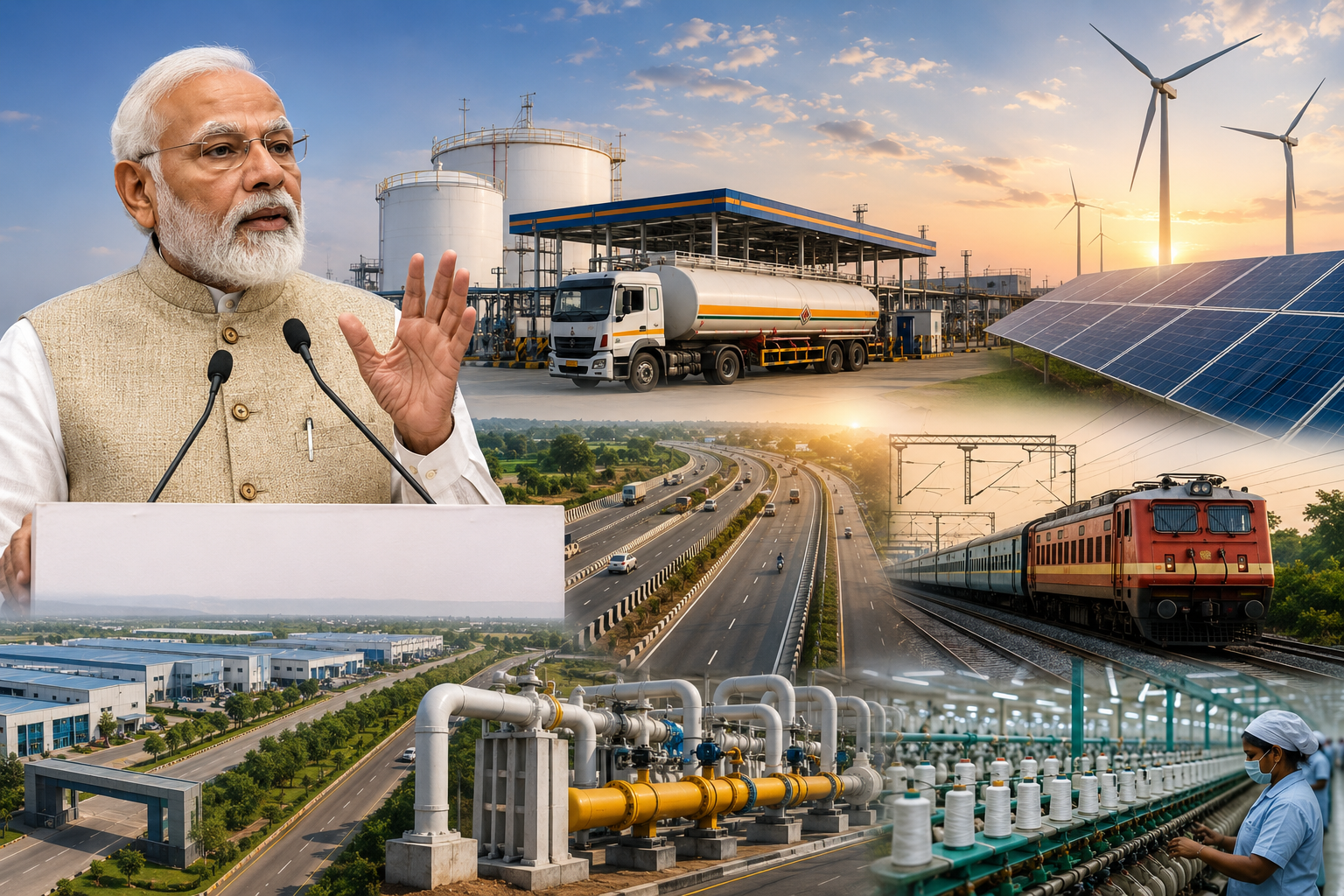
Addressing a public event in Telangana, where he virtually inaugurated and laid the foundation stone for infrastructure and industrial projects worth around ₹9,400 crore, the Prime Minister stressed the importance of responsible energy consumption to reduce the economic impact of global conflicts and lower India’s dependence on imported fuel.
The remarks come at a time when international crude oil markets remain volatile due to geopolitical tensions in the Middle East, raising concerns about inflation, fuel prices and India’s import bill.
PM Modi Highlights Importance of Energy Conservation
During his address at the Hyderabad International Convention Centre (HICC), PM Modi said India must use imported petro products only according to genuine necessity.
He noted that restrained fuel usage would not only help conserve foreign exchange reserves but also reduce the adverse economic effects of global conflicts and energy disruptions.
The Prime Minister emphasised that India has already made substantial progress in diversifying its energy ecosystem over the last few years through renewable energy expansion, ethanol blending and cleaner fuel initiatives.
Analysts believe the statement reflects growing government focus on long-term energy security as global supply chain risks and geopolitical instability continue impacting commodity markets worldwide.
India Accelerating Renewable and Cleaner Energy Transition
PM Modi highlighted India’s achievements in renewable energy, particularly in solar power generation, where the country has emerged among the leading nations globally.
He also pointed to the rapid expansion of ethanol blending in petrol, a key initiative aimed at reducing crude oil imports and supporting domestic agriculture.
The government has simultaneously expanded access to LPG connections, promoted piped natural gas infrastructure and increased investments in compressed natural gas (CNG)-based transport systems.
These initiatives form part of India’s broader strategy to gradually reduce dependence on imported fossil fuels while strengthening energy sustainability and environmental goals.
Experts note that India remains one of the world’s largest crude oil importers, making the economy highly sensitive to fluctuations in global oil prices.
₹9,400 Crore Telangana Projects Focus on Connectivity and Industrial Growth
Apart from energy-related concerns, the Prime Minister also unveiled and inaugurated multiple infrastructure projects aimed at boosting industrial growth, logistics connectivity and manufacturing capacity in Telangana.
The projects include:
- Four-laning of National Highway-167 on the Hyderabad–Panaji Economic Corridor
- Development of the Zaheerabad Industrial Area in Sangareddy district
- Multi-tracking railway sections on the Kazipet–Vijayawada route
- Greenfield POL (Petroleum, Oil and Lubricants) Terminal in Hyderabad
- Kazipet Rail Under Bypass infrastructure
- Operational launch of the PM MITRA textile park in Warangal
The projects are expected to improve regional logistics efficiency, industrial activity and employment generation in Telangana over the coming years.
PM MITRA Park Marks Major Textile Manufacturing Milestone
One of the key highlights of the event was the inauguration of the PM MITRA Park at Warangal, also known as the Kakatiya Mega Textile Park.
Developed at an estimated cost of around ₹1,700 crore, the facility is India’s first fully operational PM MITRA Park and forms part of the Centre’s broader strategy to strengthen domestic textile manufacturing and exports.
The initiative supports the government’s “5F Vision” — Farm to Fibre to Factory to Fashion to Foreign — aimed at building integrated textile value chains and improving India’s competitiveness in global apparel and textile markets.
Industry experts believe integrated textile parks can attract private investment, reduce logistics costs and create large-scale employment opportunities across manufacturing and ancillary sectors.
Infrastructure Push Continues Despite Global Economic Challenges
PM Modi stated that India is simultaneously moving forward with structural reforms and modern infrastructure development despite global economic uncertainties.
He assured citizens that the Centre would continue accelerating investments in roads, railways, industrial corridors, logistics and energy infrastructure to support long-term economic growth.
The government has significantly increased public capital expenditure in recent years, positioning infrastructure development as a major driver of domestic demand, employment generation and industrial expansion.
Economists believe sustained infrastructure spending could help India maintain economic momentum even amid slowing global growth conditions.
Energy Security Becoming Strategic Priority for India
India’s growing emphasis on energy conservation and alternative fuel infrastructure reflects broader strategic concerns regarding energy security.
Rising geopolitical tensions in oil-producing regions, supply chain disruptions and volatile commodity markets have increased pressure on large energy-importing economies like India.
The government’s continued investments in renewable energy, electric mobility, biofuels and gas infrastructure are increasingly being viewed as both economic and strategic necessities.
Experts believe reducing crude oil dependency over the long term could help India strengthen macroeconomic stability, control inflation risks and improve trade balance management.
Telangana Positioned as Emerging Industrial and Logistics Hub
The large-scale infrastructure investments announced during the event are also expected to strengthen Telangana’s position as a major industrial and logistics destination in southern India.
Improved road connectivity, railway capacity and industrial infrastructure could attract investments in manufacturing, warehousing, textiles, chemicals and logistics sectors.
The state has emerged as one of India’s faster-growing industrial economies in recent years, supported by investments in technology, pharmaceuticals, aerospace and urban infrastructure.
With fresh public infrastructure spending and industrial expansion initiatives underway, Telangana may continue attracting significant private sector investment over the next decade.