Employee Association Warns of Career Stagnation, Low Morale and Workforce Planning Failures at Central Bank
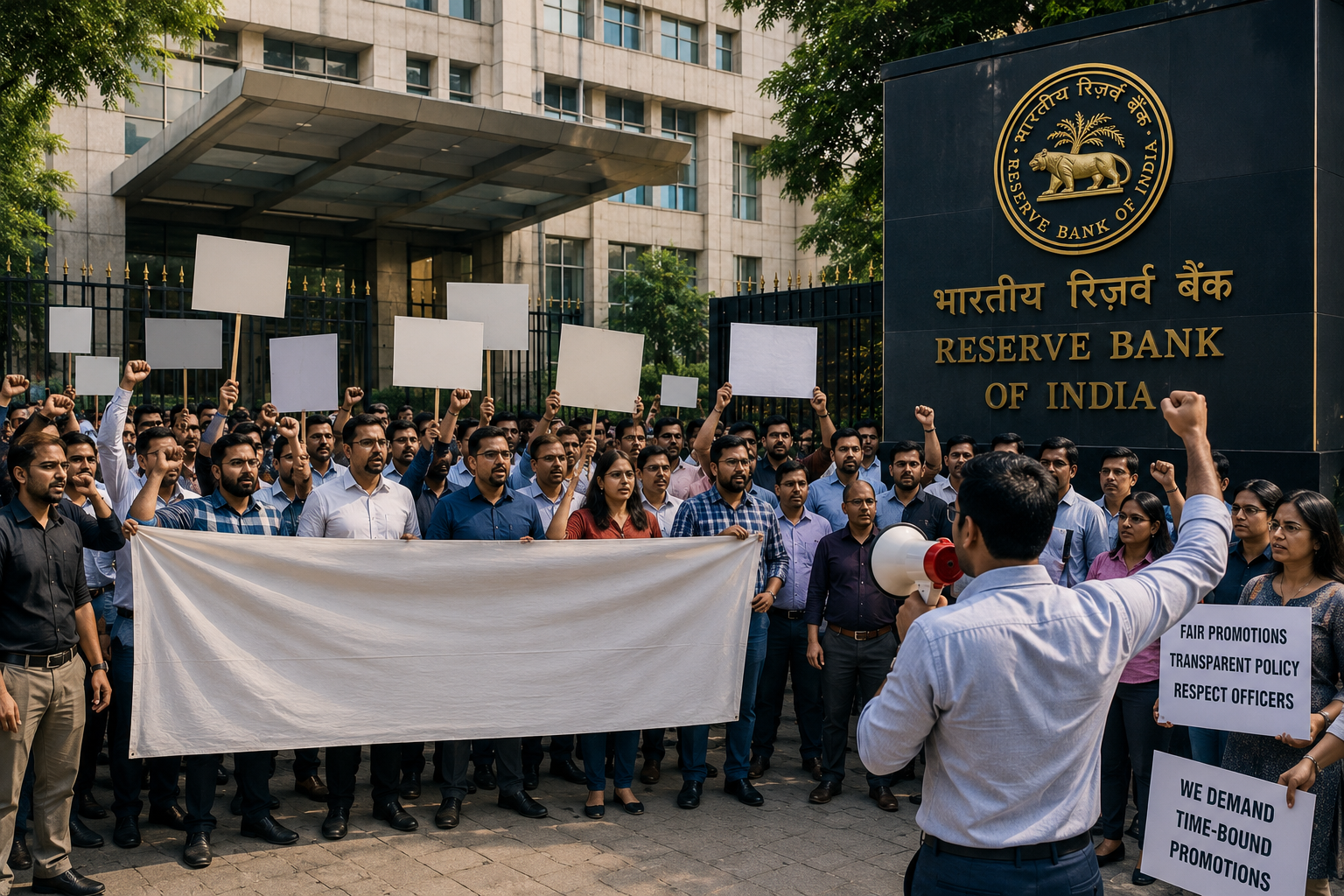
The Reserve Bank of India is facing growing internal unrest as protests by officers against the central bank’s newly introduced promotion policy intensify across multiple regional offices.
The RBI Officers' Association (RBIOA) has announced that demonstrations will continue this week, with employees demanding a comprehensive review of the revised promotion framework, which officially came into effect recently.
The protests have brought attention to deeper concerns around career progression, manpower planning and employee morale within one of India’s most influential financial institutions.
Protests Spread Across RBI Regional Offices
Demonstrations were held on Friday at several RBI offices including Mumbai, Jaipur and Hyderabad, where officers staged protests within office premises against the revised policy.
Employee associations from different RBI regions have submitted formal memorandums to local office heads requesting that their concerns be escalated to RBI Governor Sanjay Malhotra.
Union representatives indicated that further protests and coordinated employee actions may continue in the coming days if discussions with the central bank leadership fail to produce a resolution.
The situation is being closely watched within India’s financial sector, as prolonged internal discontent at the RBI could impact administrative functioning and workforce morale.
Promotion Delays and Career Stagnation at Core of Dispute
The RBI Officers’ Association has strongly criticised the revised promotion framework, arguing that it creates uncertainty and delays in career advancement for officers across various grades.
According to the association, the biggest concern is the increasing stagnation faced by employees due to what it described as “haphazard recruitment” and inadequate long-term manpower planning.
Officials claim that employees are being forced to remain in the same grade for extended periods, reducing motivation and limiting professional growth opportunities.
The association has demanded the introduction of time-bound promotions across all officer levels from Grade A to Grade E, ensuring predictable and transparent career progression within the organisation.
Employee representatives argue that the issue is structural in nature and cannot be resolved merely through tighter promotional filters or restrictive evaluation mechanisms.
Association Seeks Immediate Review of New Policy
In its communication to RBI management, the officers’ body urged the central bank to place the revised promotion policy in abeyance until broader consultations are conducted.
The association stated that the policy, in its current form, has caused “widespread dissatisfaction, frustration and demoralisation” among officers across cadres.
RBIOA has called for a structured consultation mechanism between employee representatives and RBI leadership to jointly review promotion criteria, staffing requirements and long-term workforce planning.
Union representatives believe that employee participation in policy design is essential to maintain institutional stability and avoid long-term dissatisfaction among officers.
Workforce Planning Challenges Come Into Focus
The dispute has also highlighted broader workforce management issues within India’s central banking system.
Experts note that public institutions, including regulatory bodies, increasingly face challenges related to talent retention, internal mobility and career progression, especially as private sector financial firms continue offering faster growth opportunities and higher compensation.
The RBI has historically been regarded as one of India’s most prestigious financial institutions, attracting highly skilled professionals in economics, banking regulation, supervision and monetary policy.
However, prolonged delays in promotions and limited upward mobility could affect employee engagement and retention over time, particularly among younger officers.
Impact on RBI Operations Likely to Remain Limited
Despite the ongoing protests, analysts believe the demonstrations are unlikely to disrupt the RBI’s core monetary policy, regulatory or financial market operations in the near term.
The protests remain largely administrative and employee-focused rather than operational in nature. However, prolonged dissatisfaction could eventually impact institutional efficiency and internal coordination if unresolved.
The central bank has not yet issued a detailed public response to the officers’ demands, though discussions between management and employee representatives are expected to continue.
Why the Issue Matters for Financial Markets
While the dispute is primarily related to internal human resource policy, it carries broader significance because of the RBI’s critical role in India’s financial system.
The RBI oversees monetary policy, banking regulation, currency management, inflation control and financial stability. Any signs of prolonged institutional friction within the central bank are closely monitored by financial markets and policymakers.
Investors and analysts generally view organisational stability within regulatory institutions as important for maintaining confidence in financial governance and policy continuity.
Employee Expectations Changing Across Institutions
The RBI protests also reflect a larger shift taking place across India’s workforce, where employees increasingly expect transparent career growth, structured promotions and better workplace engagement.
Post-pandemic workplace trends, rising competition for skilled talent and changing employee expectations are pushing even highly prestigious public institutions to revisit traditional human resource structures.
For the RBI, the challenge now lies in balancing organisational efficiency, merit-based evaluation and employee satisfaction while preserving the institution’s credibility and operational stability.