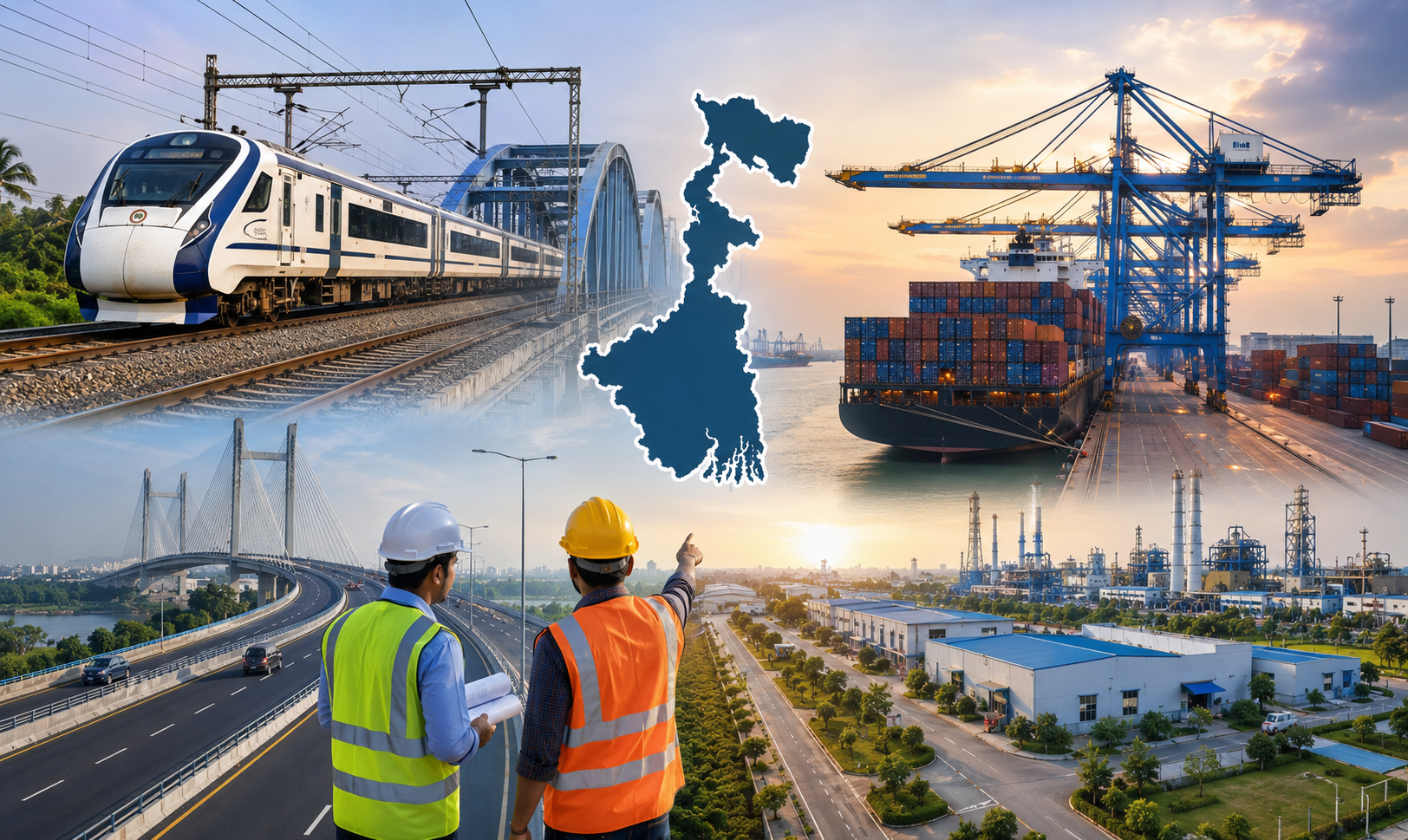
Stalled Railway Projects, Coastal Economic Zones and Industrial Corridors Likely to Receive Fresh Momentum
The formation of the Bharatiya Janata Party government in West Bengal for the first time is expected to trigger a major infrastructure and industrial development push across the state.
With political alignment now established between the Centre and the state administration, policymakers and industry experts anticipate faster approvals, improved Centre-state coordination and accelerated execution of long-delayed infrastructure projects.
The new government has strongly emphasised the concept of “double-engine development,” a model that seeks to synchronise state and Central Government initiatives to drive economic growth, connectivity and investment.
Railway Projects Expected to Gain Speed
One of the most significant areas expected to benefit from the political transition is railway infrastructure.
Several railway expansion and modernisation projects in West Bengal had reportedly faced delays over the years due to land acquisition issues, administrative hurdles and coordination gaps between the previous state administration and the Centre.
Officials now expect faster clearances for pending railway lines, freight connectivity projects, suburban rail upgrades and station redevelopment plans.
Key industrial and logistics corridors connecting Kolkata, Durgapur, Asansol, Siliguri and Haldia are likely to receive renewed focus as part of a broader effort to strengthen eastern India’s transportation network.
Analysts believe improved railway infrastructure could significantly reduce logistics costs, improve freight efficiency and support manufacturing growth across eastern and northeastern India.
Coastal Economic Zones Could Transform Bengal’s Economy
Infrastructure-led industrialisation formed a major part of the BJP’s election campaign in West Bengal. Among the most ambitious proposals was the development of coastal economic zones aimed at integrating Bengal’s coastal economy into global supply chains.
The state’s strategic location along the Bay of Bengal provides strong opportunities for export-driven industries, maritime trade and logistics infrastructure development.
Experts believe sectors such as petrochemicals, shipbuilding, fisheries, renewable energy, food processing, warehousing and port-led manufacturing could benefit significantly from the proposed coastal development strategy.
As global companies continue diversifying supply chains beyond traditional manufacturing hubs, West Bengal could position itself as an important eastern trade gateway for both domestic and international businesses.
Port Modernisation and Logistics Expansion in Focus
The Centre is also expected to prioritise modernisation of ports and logistics infrastructure in the state.
Improved port connectivity through highways, rail freight corridors and inland waterways could strengthen trade movement across eastern India and neighbouring countries in South Asia and Southeast Asia.
Ports linked to the Bay of Bengal are increasingly being viewed as strategically important for India’s maritime trade ambitions under larger national logistics and infrastructure initiatives.
Industry observers believe logistics parks, multimodal transport hubs and warehousing infrastructure could witness increased investment under the new policy environment.
Industrial Investment Climate May Improve
Business leaders and investors are closely watching whether the new political alignment can improve West Bengal’s industrial investment climate after years of policy uncertainty and stalled projects.
The state possesses strong advantages including a large workforce, strategic geographic positioning, established urban centres and access to eastern and northeastern markets. However, investors have often raised concerns regarding project execution delays and land-related challenges.
The new administration is expected to focus on simplifying project approvals, improving industrial clearances and strengthening coordination with Central ministries.
Sectors likely to attract attention include manufacturing, chemicals, engineering, logistics, renewable energy, urban infrastructure and information technology.
Infrastructure Push Could Boost Employment and Consumption
A large-scale infrastructure revival could also generate substantial employment opportunities across construction, transportation, manufacturing and services sectors.
Government-led capital expenditure on roads, railways, ports and industrial infrastructure tends to create both direct and indirect economic activity. Analysts believe improved infrastructure could stimulate private investment, increase regional trade and support urban development in multiple districts.
Higher employment generation and industrial activity may also strengthen consumer demand and improve economic growth prospects within the state.
Double-Engine Governance Becomes Core Development Narrative
The BJP government has repeatedly highlighted “double-engine governance” as a central pillar of its development strategy for West Bengal.
The phrase refers to closer alignment between the state and Central Government on policy execution, funding support and infrastructure implementation. Supporters argue that such coordination can accelerate large public projects that require approvals and financing from multiple agencies.
The Centre is expected to increase support for strategic projects in transportation, housing, industrial corridors and digital infrastructure under this framework.
Bengal’s Strategic Importance Rising in India’s Growth Story
West Bengal’s geographic position gives it growing importance in India’s long-term economic and trade strategy.
The state serves as a gateway to northeastern India and shares international borders with Bangladesh, Nepal and Bhutan. Improved connectivity infrastructure could strengthen cross-border trade, logistics integration and export competitiveness.
As India expands its focus on eastern economic corridors, maritime trade routes and global manufacturing integration, West Bengal could emerge as one of the country’s most strategically important growth regions over the next decade.
The success of the new infrastructure push, however, will ultimately depend on execution speed, policy consistency and the government’s ability to attract long-term private investment alongside public sector spending.