From Covid-Era Survival Strategy to Corporate Culture Battle, India’s Five-Year WFH Journey Reshapes the Future of Work
Prime Minister Narendra Modi’s recent appeal encouraging citizens and companies to adopt work-from-home (WFH) practices as a fuel-saving measure has unexpectedly reignited one of the biggest workplace debates in modern India.
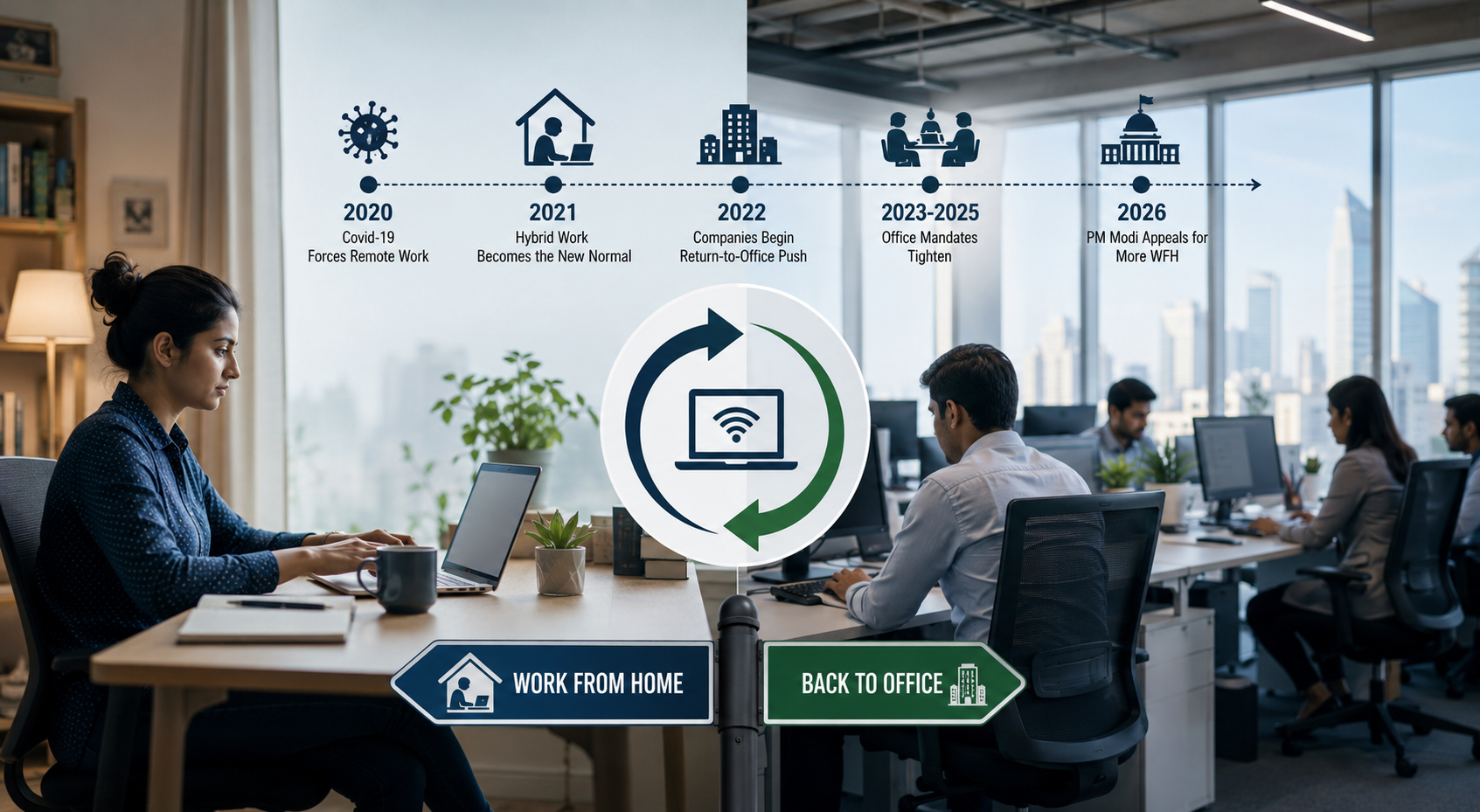
What began as an emergency response during the Covid-19 lockdown in 2020 evolved into a nationwide workplace transformation that permanently changed how businesses operate, employees work and companies think about productivity. Over the past five years, India’s corporate ecosystem has witnessed a dramatic shift from mandatory remote work to hybrid flexibility and finally toward strict office attendance mandates.
Now, amid global energy concerns and rising geopolitical tensions, the work-from-home discussion is returning for an entirely different reason.
2020: Covid-19 Pushes India Into the Largest Remote Work Experiment
India’s work-from-home journey began suddenly in March 2020 when the nationwide Covid-19 lockdown forced millions of employees to stay indoors and companies to shut physical offices overnight.
The abrupt transition created panic across industries as organisations struggled to maintain operations remotely. IT and technology firms moved quickly to digitise workflows, distribute laptops and secure remote network access for employees.
Major Indian IT companies including Tata Consultancy Services, Infosys and Wipro rapidly adapted to the new work culture, enabling thousands of employees to operate from home within weeks.
However, industries dependent on physical infrastructure — including manufacturing, hospitality, aviation, retail and construction — suffered severe operational disruptions. Many businesses faced layoffs, salary cuts and temporary shutdowns during the prolonged lockdown period.
The pandemic also accelerated India’s digital transformation. Video conferencing platforms, cloud computing, remote collaboration software and virtual client meetings became mainstream across corporate India.
TCS further institutionalised the shift by introducing its ambitious “25x25” strategy, envisioning a future where only 25 per cent of employees would need to work from offices by 2025.
2021: Hybrid Work Emerges as the New Corporate Model
As Covid restrictions gradually eased in 2021, businesses began reopening offices cautiously. Yet, the success of remote work during the pandemic had fundamentally changed employee expectations regarding flexibility and work-life balance.
Instead of fully returning to traditional office culture, many companies embraced hybrid work models that allowed employees to split their time between home and office.
According to a workplace survey conducted by NASSCOM, nearly 70 per cent of organisations planned to continue hybrid work arrangements even after the pandemic.
The rise of hybrid work also transformed India’s hiring ecosystem. Companies increasingly adopted remote-first recruitment policies, enabling them to hire talent from smaller cities and towns beyond metropolitan centres.
Food delivery platform Swiggy became one of the most prominent examples when it announced a permanent work-from-anywhere policy for many roles. The move enabled the company to recruit professionals from hundreds of cities across India, including tier-2 and tier-3 markets.
At the same time, India’s commercial real estate sector experienced significant disruption. Demand for office spaces weakened sharply as vacancy rates increased across major business hubs including Bengaluru, Mumbai, Gurugram and Hyderabad.
2022: Employees Resist Full Return to Offices
By 2022, vaccination coverage had improved significantly and Covid-related restrictions were largely removed. Companies began pushing employees to return to offices, arguing that in-person collaboration improved teamwork, creativity and organisational culture.
However, many employees strongly resisted returning full-time.
After spending nearly two years working remotely, professionals had grown accustomed to flexible schedules, reduced commute stress and better work-life integration. Employees increasingly questioned the need for long daily commutes when productivity levels remained stable while working remotely.
This phase created a major cultural conflict between employers and employees.
Companies promoted the importance of collaboration and office culture, while employees prioritised flexibility and autonomy. During this period, workplace trends such as “quiet quitting” and “moonlighting” became widely discussed across corporate India, reflecting changing attitudes toward work and employee engagement.
2023 to 2025: Corporate India Tightens Office Attendance Rules
As economic uncertainty and global slowdown concerns intensified between 2023 and 2025, companies gradually strengthened return-to-office policies.
Large IT firms led the shift toward stricter attendance mandates. Many organisations introduced compulsory hybrid attendance models requiring employees to work from offices at least three days a week.
TCS stated in 2024 that office attendance had returned close to pre-pandemic levels after sustained efforts to bring employees back to campuses. Meanwhile, HCLTech reportedly introduced leave deductions linked to office attendance compliance, while Cognizant warned employees about disciplinary action for repeated non-compliance.
E-commerce giant Flipkart further intensified the trend in 2025 by ending its work-from-home policy and asking employees to return to offices five days a week.
Companies argued that face-to-face interaction improved productivity, innovation and employee coordination. However, many employees viewed the shift as a rollback of the flexibility gained during the pandemic years.
2026: PM Modi Reopens the WFH Conversation
In 2026, the work-from-home debate has resurfaced again — but this time driven by energy conservation concerns rather than a public health crisis.
Against the backdrop of global energy market volatility and geopolitical tensions in West Asia, PM Modi appealed to citizens and businesses to consider WFH practices as a fuel-saving measure to reduce national energy consumption.
Unlike the Covid lockdown period, the government has not introduced any formal directive or mandatory restrictions. Instead, the appeal has been framed as a voluntary civic contribution toward national energy security.
Even without formal mandates, the Prime Minister’s remarks have revived conversations across corporate India about remote work, employee flexibility and sustainable workplace models.
The Future of Work in India Remains Unsettled
Five years after India’s largest work-from-home experiment began, the future of office culture remains uncertain.
Many companies now recognise that hybrid work is likely to remain a permanent part of the corporate ecosystem, especially in technology, consulting and digital sectors. At the same time, businesses continue balancing flexibility with concerns around collaboration, productivity and organisational culture.
For employees, the pandemic permanently changed expectations around work-life balance and flexibility. For companies, it triggered a long-term reassessment of office infrastructure, talent acquisition and workforce management.
As India navigates economic growth, urban congestion, rising fuel costs and digital transformation, the work-from-home debate may continue evolving far beyond its Covid-era origins.