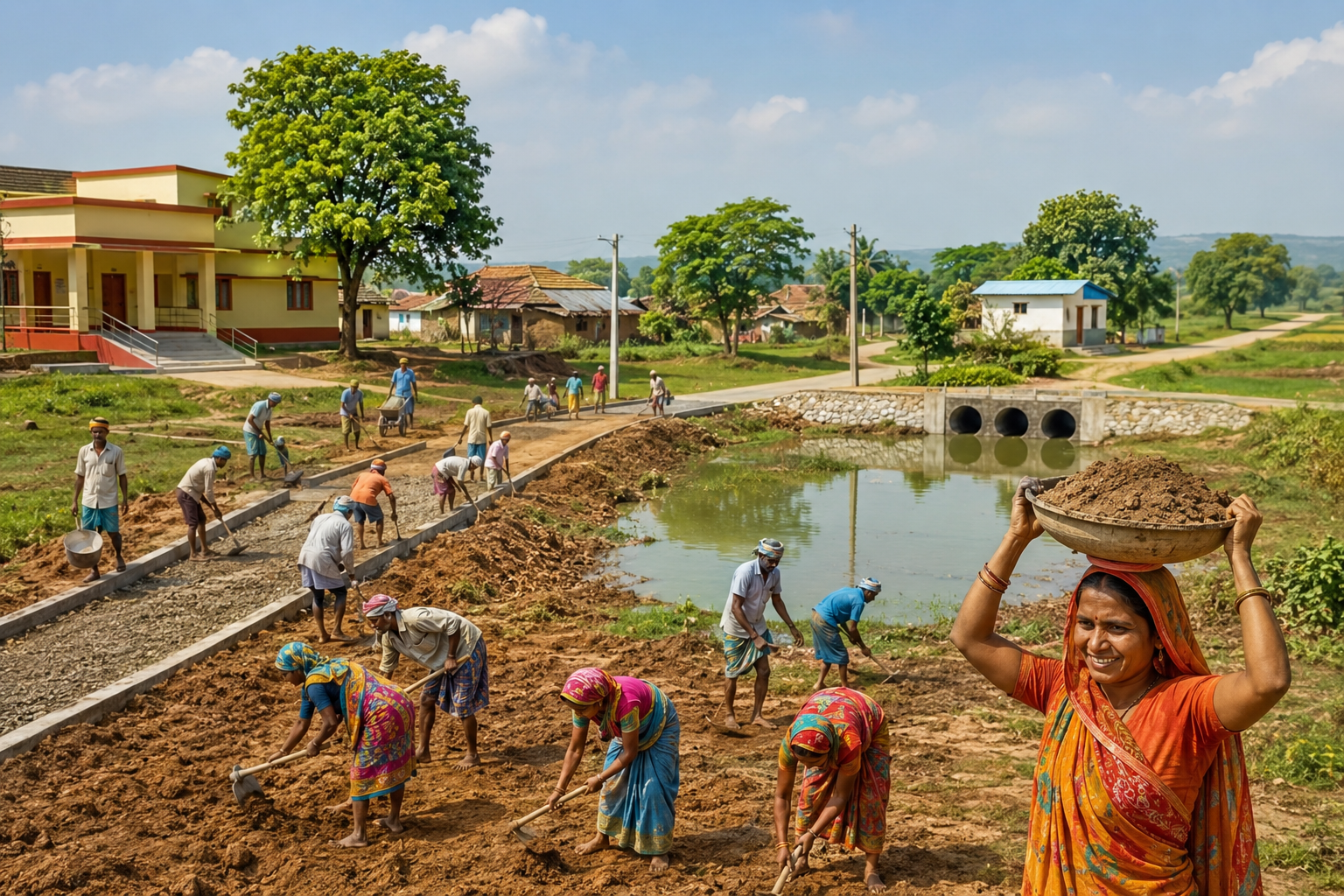
New Rural Employment Framework to Guarantee 125 Days of Work and Boost Village Infrastructure
NEW DELHI: In a major policy shift aimed at transforming rural employment and infrastructure development, the Centre has officially notified the implementation of the Viksit Bharat–Guarantee for Employment and Livelihood Mission (Rural), popularly known as the VB–G RAM G Act. The new framework will replace the existing Mahatma Gandhi National Rural Employment Guarantee Act (MGNREGA) across the country from July 1, 2026.
The decision marks one of the most significant overhauls in India’s rural welfare and employment ecosystem in nearly two decades. The government said the transition would be carried out in a phased manner to ensure uninterrupted employment and smooth continuation of ongoing rural development projects.
Employment Guarantee Increased to 125 Days
Under the new law, rural households will receive a guaranteed 125 days of employment annually, an increase from the existing 100 days under MGNREGA. Union Agriculture and Rural Development Minister Shivraj Singh Chouhan said the move is aimed at creating stronger livelihood support for rural workers while accelerating the pace of infrastructure creation in villages.
The minister assured that all ongoing works under MGNREGA would continue during the transition period and no labourer would be deprived of employment due to administrative changes. States have been given up to six months to complete operational readiness under the new framework.
Massive Budget Allocation Signals Infrastructure Push
The Centre has allocated more than ₹95,000 crore for the programme in the Union Budget, while states are expected to contribute additional resources through separate allocations. Combined annual expenditure under the scheme is projected to exceed ₹1.51 trillion.
Experts believe the scale of spending highlights the government’s focus on rural infrastructure as a key driver of economic growth, employment generation and consumption demand in smaller towns and villages.
The programme will support large-scale public works including:
- Water conservation and irrigation projects
- Rural roads, bridges and culverts
- School and anganwadi construction
- Farm-linked infrastructure
- Flood-control and disaster mitigation structures
- Livelihood assets for self-help groups and farmer producer organisations
Focus on Rural Economy and Consumption Growth
Economists say the enhanced rural employment guarantee could support rural consumption, which remains a crucial pillar for India’s economic growth. Higher wage flows into villages are expected to boost demand for FMCG products, agricultural inputs, consumer goods and affordable housing materials.
Analysts believe sectors such as cement, construction materials, pipes, rural banking, agro-equipment and microfinance institutions could benefit from increased infrastructure spending and improved rural cash flow.
The scheme is also expected to create opportunities for local contractors, rural entrepreneurs and small-scale manufacturing units connected to public infrastructure development.
Direct Benefit Transfers and Faster Wage Payments
The government said wages under the VB–G RAM G framework would continue to be transferred directly into workers’ bank or post office accounts through the direct benefit transfer (DBT) mechanism.
Authorities aim to process wage payments within three days, although the law mandates completion within 15 days. Workers will also be eligible for compensation in case of delayed payments, while unemployment allowance provisions will remain applicable if work is not provided on demand.
To strengthen implementation efficiency, the administrative expenditure ceiling has been increased from 6 per cent to 9 per cent. Officials said the additional allocation would improve staffing support, monitoring systems and timely salary payments for field-level workers.
Political and Economic Significance
The rollout of the VB–G RAM G Act is being viewed as a politically and economically significant reform ahead of the government’s long-term rural development roadmap. Officials said the initiative aligns with Prime Minister Narendra Modi’s vision of creating “developed villages for a developed India.”
Policy experts believe the success of the scheme will depend on implementation quality, timely fund flow and coordination between the Centre and states. If executed efficiently, the programme could strengthen rural employment security while simultaneously accelerating infrastructure development across India’s villages.
The transition from MGNREGA to the new framework is expected to be closely watched by economists, state governments and rural development experts over the coming months.